

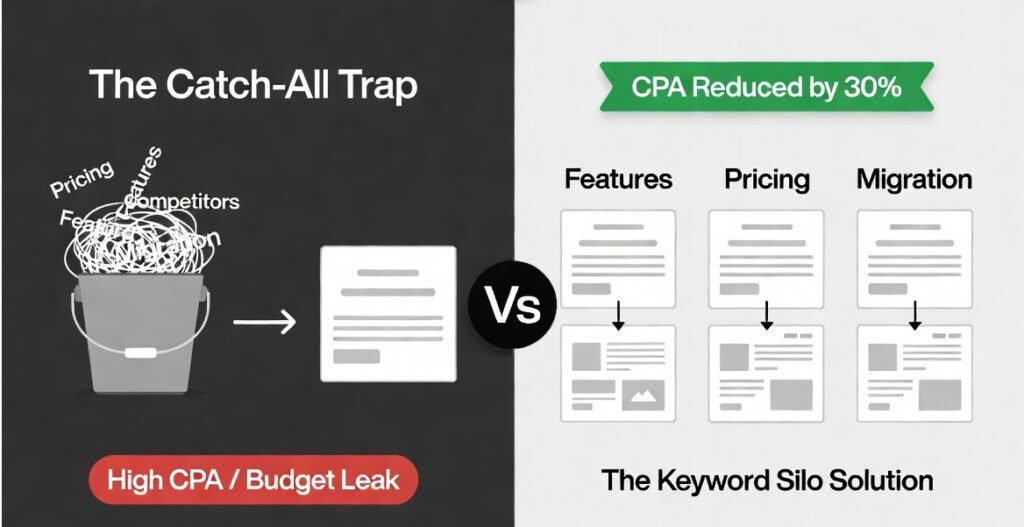
See how we cut CPA by 30% via siloing. It is a bold claim, but when you rebuild a fundamentally flawed PPC account structure, the results speak for themselves.
At Click Squad, we audit dozens of Google Ads accounts every single month. We consistently see the exact same mistake across nearly every industry, from B2B SaaS to local commercial plumbing. Businesses pour thousands of dollars into campaigns that are bleeding budget because their keywords are shoved into massive, disorganised ad groups.
When keywords lack tight themes, your ad relevance drops. According to official Google Ads Support documentation on Quality Score, low ad relevance directly plummets your overall score. A degraded Quality Score inflates your Cost Per Click (CPC) and subsequently pushes your CPA through the roof.
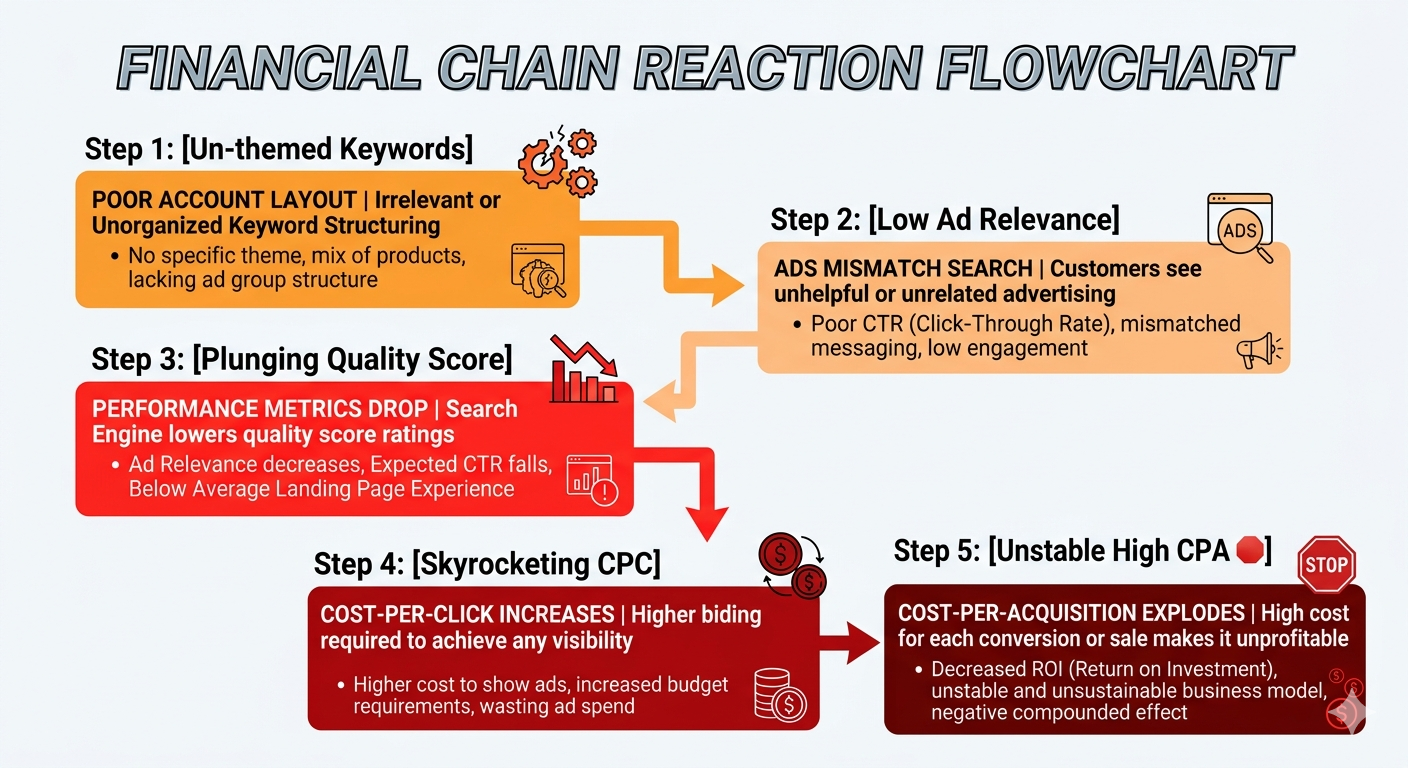
This case study breaks down exactly how we rescued a high-spend B2B client by completely overhauling their PPC account structure, resulting in a 30% reduction in CPA and a massive increase in highly qualified conversions.
The Problem: The “Catch-All” Ad Group Trap
The client, an enterprise software provider, came to us frustrated. They were generating a decent volume of leads, but the cost to acquire those leads was completely unsustainable. Their internal marketing team was constantly increasing bids just to maintain their impression share.
We conducted a deep dive into their existing PPC account structure and immediately identified the core issue: the “Catch-All” Ad Group.
Their campaigns were structured broadly by product category. Inside one of their primary ad groups, they had over 45 active keywords. The list included broad terms like “enterprise software,” highly specific terms like “cloud ERP migration tools,” and competitor terms all lumped together.
Because all 45 keywords lived in the same ad group, they all triggered the exact same ad copy.
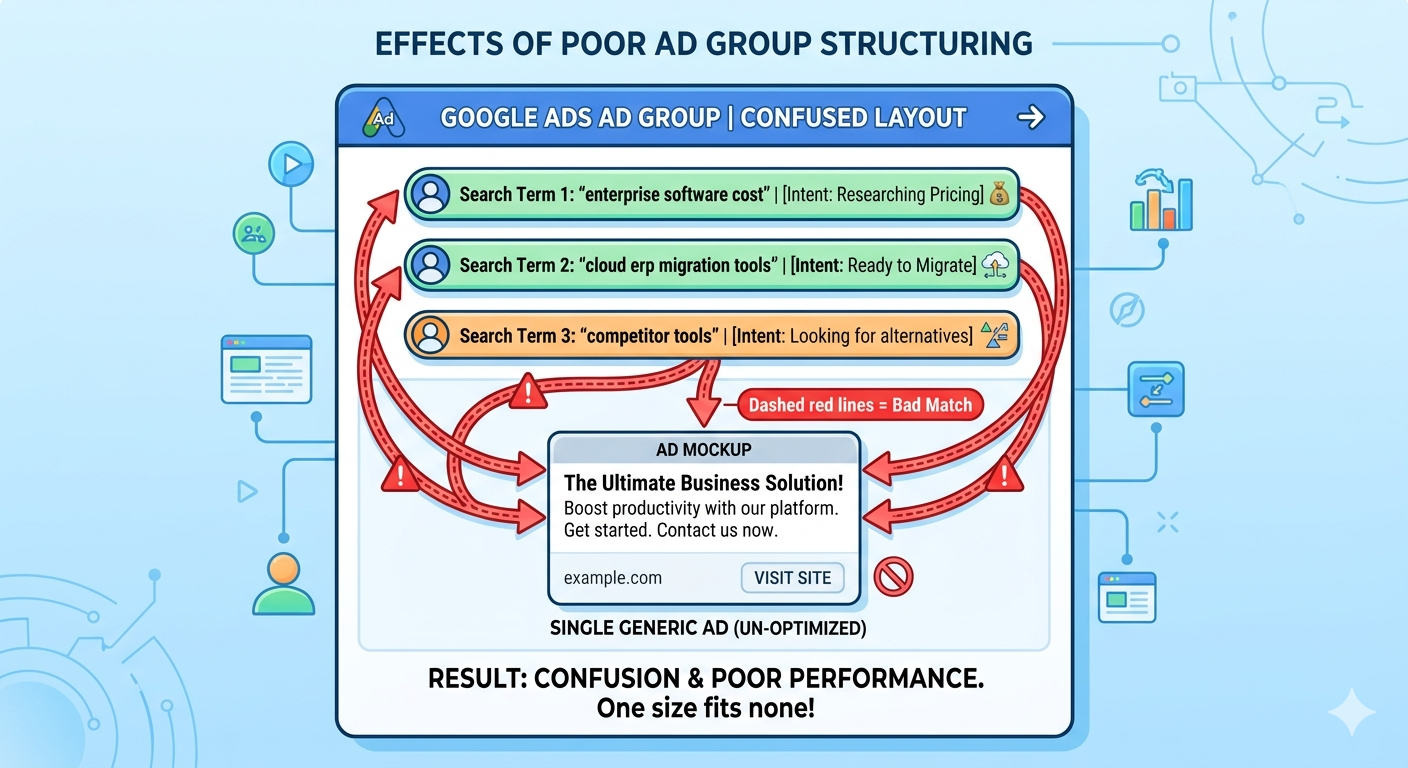
This is where the financial bleeding happens. If a user searches for “cloud ERP migration tools” and sees a generic ad headline that says “Leading Enterprise Software Solutions,” the ad feels irrelevant. The user does not click, or worse, they click, land on a generic homepage, and bounce. Harvard Business Review highlights that modern consumers expect immediate relevance; failing to deliver targeted experiences inevitably triggers friction in the digital customer journey that destroys conversion rates. Google interprets this poor user behavior and low relevance by lowering your Quality Score, forcing you to pay a massive premium to win auctions.
Google interprets this low relevance and poor landing page experience by dropping the Quality Score. The client was paying a massive premium simply because their account structure forced them to serve generic ads to specific queries.
The Solution: Implementing Keyword Siloing (SKAGs and STAGs)
To fix the CPA crisis, we needed to rebuild the foundation. We deployed a strict Keyword Siloing strategy.
Siloing involves breaking massive, chaotic ad groups into hyper-specific, tightly themed units. Depending on search volume and intent, we utilise either Single Keyword Ad Groups (SKAGs) or Single Theme Ad Groups (STAGs).
Here is exactly how we executed the restructure:
Phase 1: The Forensic Keyword Audit
We did not just copy and paste their existing keywords into new groups. We analysed the search term report for the past 12 months. We identified the exact queries that were actually driving conversions and separated them from the vanity keywords that were only burning budget.
We immediately paused high-volume, low-intent terms that lacked commercial viability.
Phase 2: Building Single Theme Ad Groups (STAGs)
For the remaining high-value keywords, we created highly segmented STAGs. We grouped keywords not just by the product, but by the specific search intent.
For example, instead of one massive “ERP Software” ad group, we built specific silos:
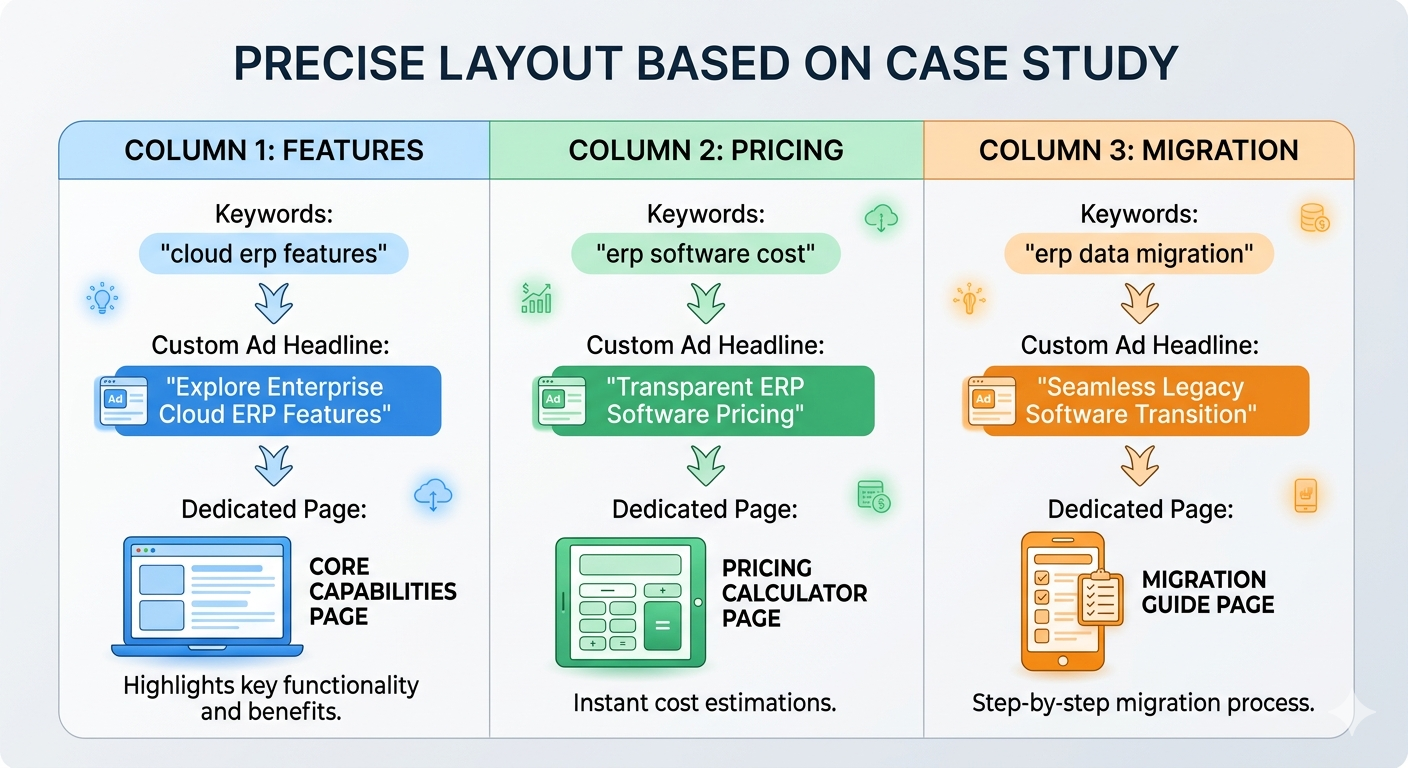
- Silo 1 (Features): Keywords focused specifically on “cloud ERP features” and “ERP software capabilities.”
- Silo 2 (Pricing): Keywords focused strictly on “ERP software cost” and “enterprise software pricing.”
- Silo 3 (Migration): Keywords dedicated to “ERP data migration” and “legacy software transition.”
Phase 3: Hyper-Relevant Ad Copy Alignment
Because the keywords were now tightly siloed, we could write ad copy that matched the exact user search query.
When a user searched for “ERP software cost,” they no longer saw a generic headline. They saw an ad that read, “Transparent ERP Software Pricing | Get a Custom Quote Today.”
The psychological impact of this alignment is massive. When the ad copy perfectly mirrors the user’s thought process, Click-Through Rates (CTR) spike dramatically.
Phase 4: Landing Page Mapping
A great ad structure means nothing if the destination fails to convert. Under the old structure, all traffic was routed to the main homepage.
We mapped every newly created STAG to a highly specific, conversion-optimised landing page. The users searching for pricing were sent directly to a pricing calculator page. The users searching for migration were sent to a technical overview page detailing the implementation process.
The Financial Results: A 30% Drop in CPA
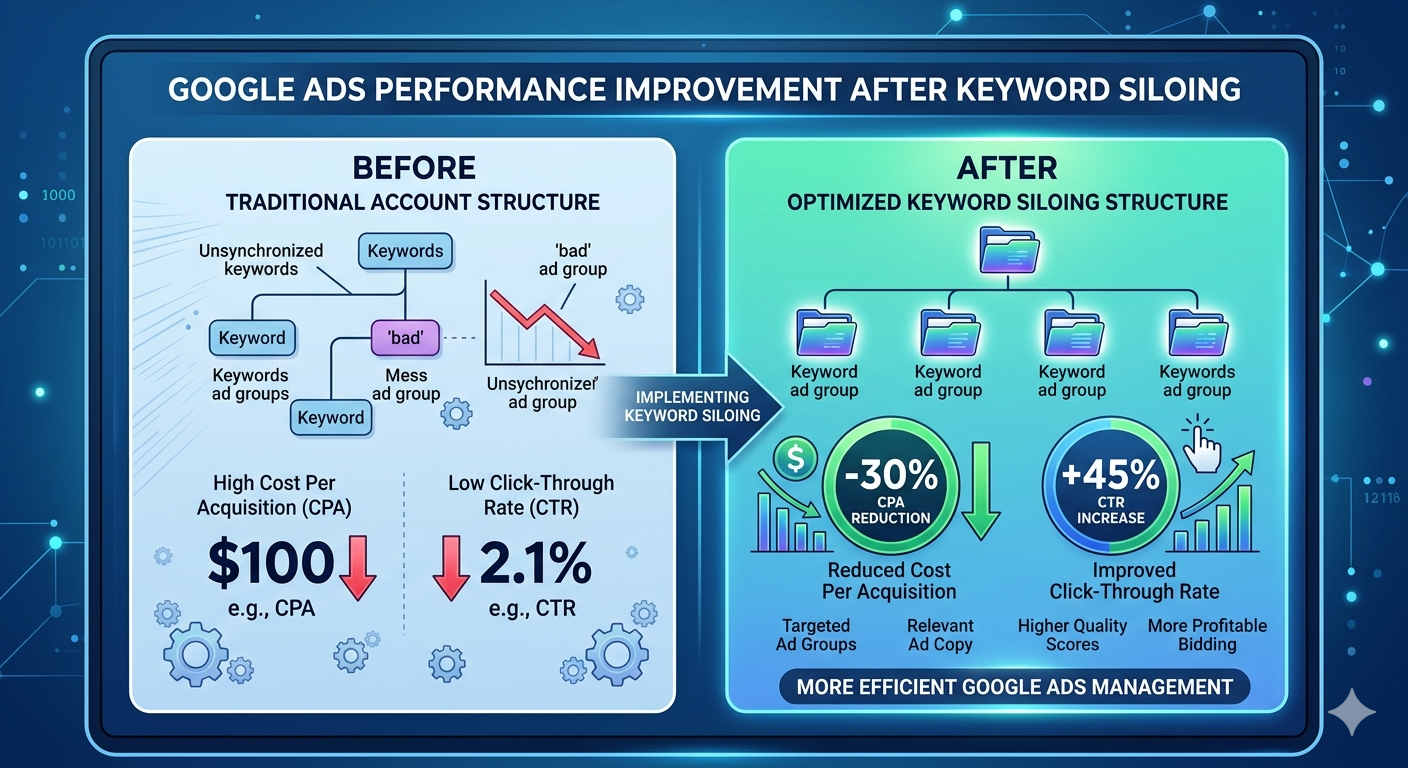
When we launched the new PPC account structure, the results validated the strategy almost immediately.
Because the new ad copy was hyper-relevant to the siloed keywords, the CTR across the entire account increased by over 45%. Google’s algorithm recognised this massive jump in user engagement and rewarded the account by dramatically increasing the Quality Scores for the core keywords.
As the Quality Scores rose from 4s and 5s to 8s and 9s, the CPC dropped significantly. The client was suddenly winning prime ad placements while paying less per click than they had under the old, generic structure.
Furthermore, because the traffic was routed to highly specific landing pages that matched the search intent, the conversion rate skyrocketed.
Within the first 60 days of the new siloed architecture, the client’s Cost Per Acquisition dropped by exactly 30%. We did not just save them money; we built a scalable engine that generated more qualified leads at a fraction of their previous cost.
Why Keyword Siloing is Mandatory for BOFU Campaigns
When you target Bottom of the Funnel (BOFU) buyers, you are targeting users who are ready to make a purchasing decision. They are no longer researching broad concepts; they are searching for exact solutions, pricing, and comparisons.
If your PPC account structure lumps these highly specific, high-intent BOFU queries into a generic ad group, you are actively driving qualified buyers into the arms of your competitors.
A sloppy account structure tells the user you do not understand their specific problem. A siloed account structure proves you have the exact answer they are looking for.
The Takeaway: Stop Paying the “Lazy Tax”
Running a poorly structured Google Ads account means you are paying what we call the “Lazy Tax.” You are paying Google extra money to compensate for your lack of relevance.
Keyword siloing requires significantly more upfront work. It takes time to audit the search term reports, build out dozens of STAGs, write hyper-specific ad copy for every variation, and map those groups to custom landing pages.
However, as this case study proves, that structural discipline is the absolute fastest way to dominate the search engine results page. When you align your keywords, your ad copy, and your landing pages into a cohesive, highly relevant journey, you stop subsidising Google’s profits and start scaling your own.
If your CPA is creeping higher month over month, do not blindly increase your budget. Look at your foundation. The fastest path to profitability is almost always found in a cleaner, more disciplined PPC account structure.