


Stop guessing. Use data to dominate search.
Most businesses treat Search Engine Marketing as a battleground between two opposing departments: the organic team (SEO) and the paid team (PPC). They split their budgets, run separate reports, and treat the two channels as completely separate strategies.
This broken approach guarantees wasted money and missed sales. Search Engine Marketing is not an “either/or” choice. It is a united system.
Quick Answer: How do SEO and PPC work together?
When combined, PPC acts as your fast testing ground to discover exactly which keywords drive the most revenue, while SEO acts as your long-term digital real estate. By taking the highest-converting search terms from your Google Ads campaigns and building trusted organic landing pages around them, you can capture high-intent buyer traffic without paying an ongoing cost per click.
Why Does PPC Provide the Best Market Research?
Google Ads provides a clear financial benefit: instant market truth. You do not have to wait six months to see if a keyword actually drives revenue.
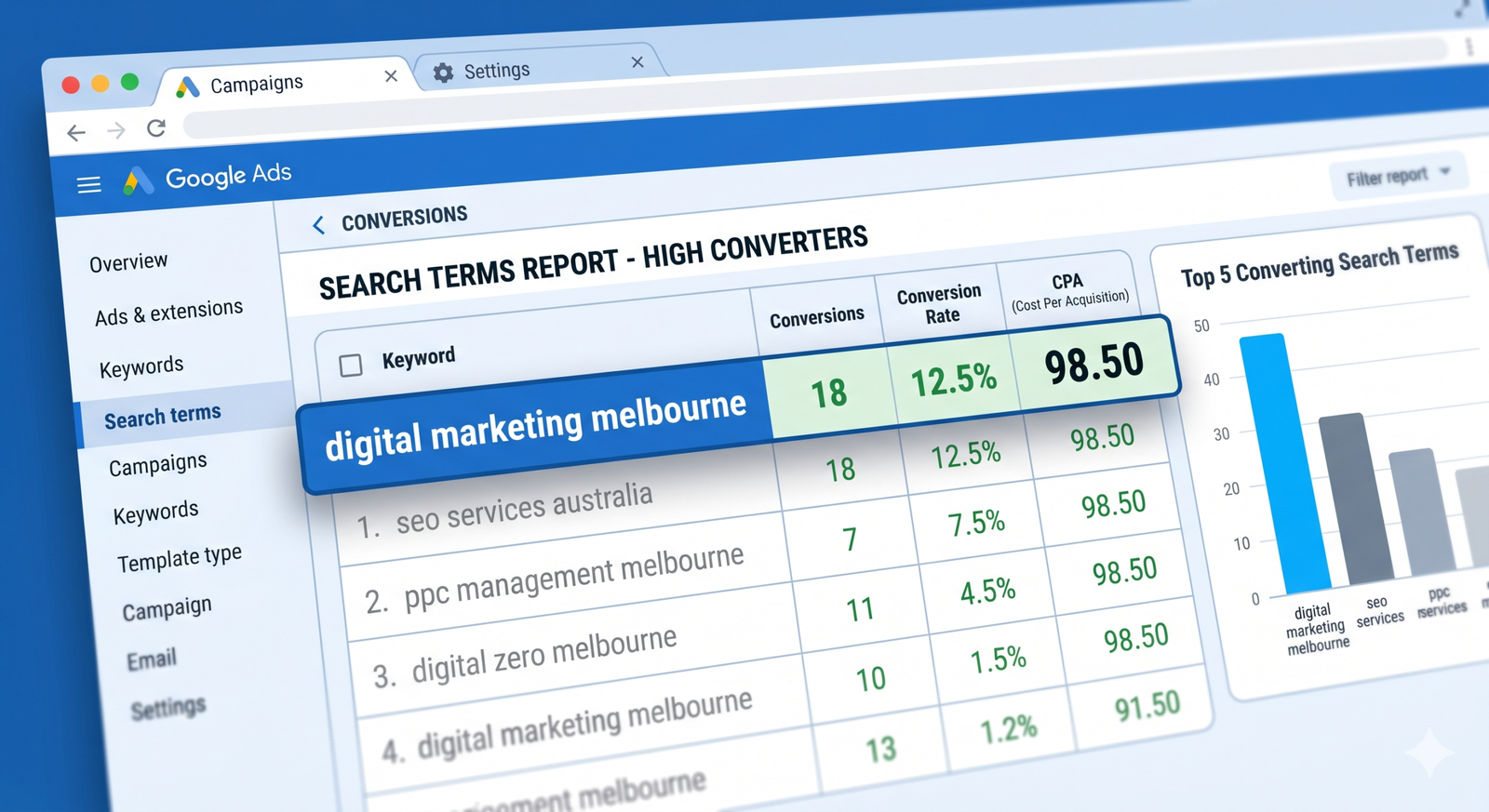
By launching targeted PPC campaigns, you can quickly identify which search terms drive the most sales. You collect useful data on Cost Per Click (CPC), conversion rates, and the exact words your customers use when they are ready to buy. You are basically paying Google to do excellent, real-time market research.
Stop paying for clicks that do not convert. Let us audit your Google Ads search terms and identify your highest-intent traffic. Get Your Free Google Ads Audit
How Can You Turn Paid Data Into SEO Value?
Think of your digital marketing like building a property. You must lay the digital foundation before you can build the penthouse. Throwing money at PPC without a long-term organic strategy is like renting a display home forever.
Instead of guessing what content to write or hoping a keyword will make money, you build trusted landing pages around proven, profitable search terms. You use the exact ad copy hooks that achieved high Click-Through Rates (CTR) in your PPC campaigns to write your organic meta titles and descriptions. As your SEO rankings rise, you begin to capture that exact same buyer traffic without paying the ongoing click tax.
Having worked in SEO since late 2015, I have seen this pairing completely transform business results. When managing the detailed technical SEO migration for Camera Warehouse, moving them from Magento Enterprise to Magento Community, we did not just move URLs. We used their past PPC search term data to rebuild their website menus and categories. We mapped the exact profitable terms Australian photographers were searching for directly into the new website structure. This Strategy First approach leverages the hard data that paid search provides to strengthen your organic real estate.
Case Study: Lowering Blended CAC in Local Markets
Let us look at a real-world example of how this plays out over a 12-month period. For local service providers like Moving Men Removals in Melbourne, fighting for visibility in a crowded market can be incredibly expensive if you rely only on paid ads.
We started with a heavy PPC push to capture immediate bookings. The data quickly showed us that specific, hyper-local searches like “furniture removalists Brunswick” and “piano movers Melbourne” had the highest conversion rates, despite high click costs.
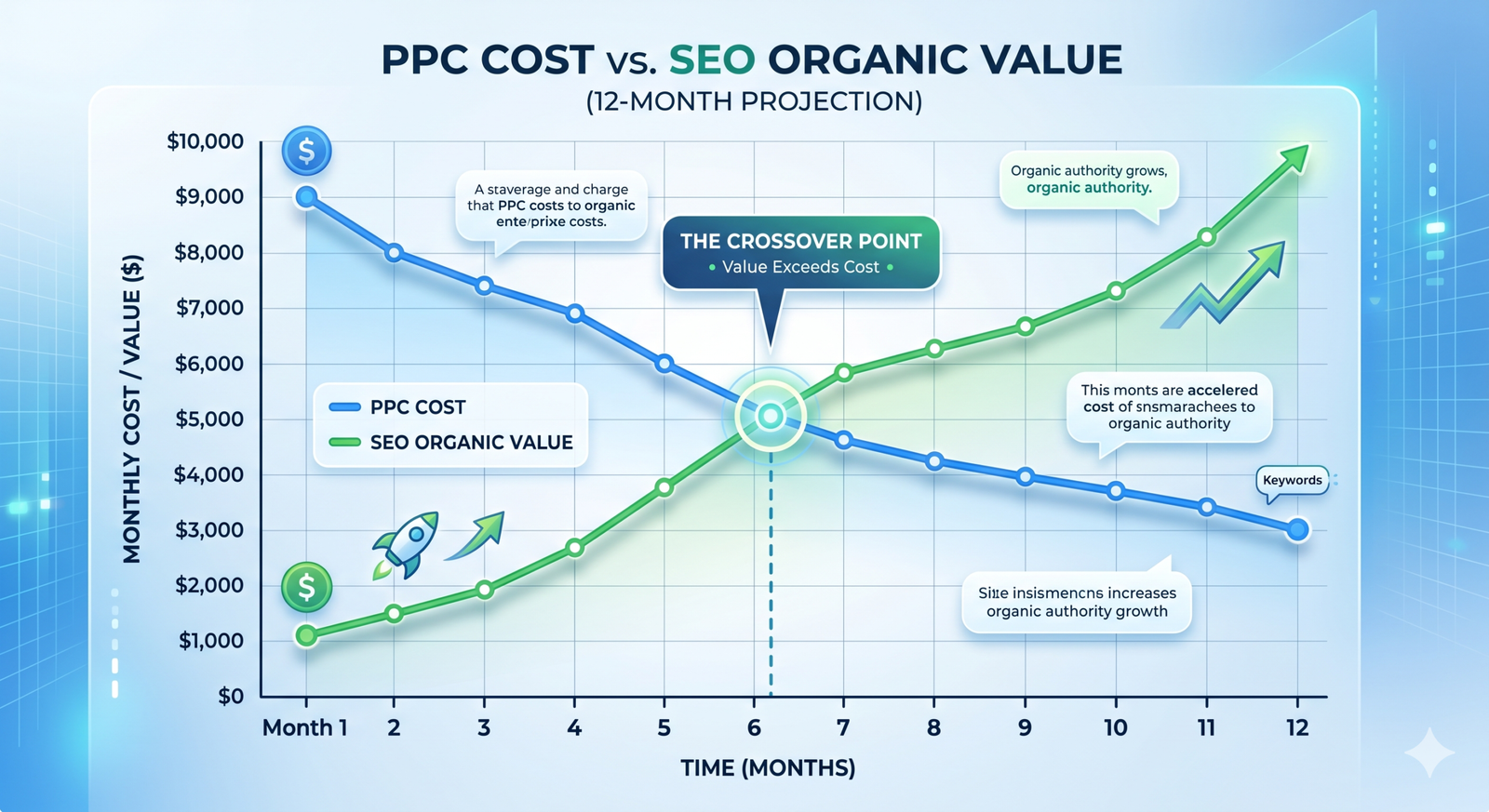
Instead of paying that high click cost forever, we mapped those exact terms to a local SEO campaign. We built dedicated, highly relevant service pages for those specific suburbs and services. Around month seven, those organic pages started hitting the top three spots on Google. We then dialled back the Google Ads budget for those specific keywords.
The result was a powerful “surround sound” effect. Prospects saw the brand in both the Sponsored and Organic sections, boosting trust. More importantly, the Blended Customer Acquisition Cost (CAC) dropped by over 40% by month twelve because the majority of their best leads were now coming from free organic clicks.
What Metrics Define the “Crossover Point”?
To properly map your search landscape, you must track when it becomes more profitable to rank organically rather than pay for clicks. We call this the Crossover Point. You identify it by tracking three specific metrics:
- Cost Per Acquisition (CPA): How much you pay Google Ads to acquire a single lead or sale.
- Organic Traffic Value: What you would have paid in Google Ads for the traffic your SEO is currently bringing in for free.
- SEO Maintenance Cost: The monthly investment required to keep your organic rankings strong.
The Crossover Point occurs the moment your Organic Traffic Value becomes higher than your SEO Maintenance Cost, while delivering leads at a lower CPA than your active Google Ads campaigns. At this exact moment, SEO becomes your most profitable channel.
Want to find your exact Crossover Point? We can build a custom 12-month mathematical model showing exactly when your SEO will overtake your PPC spend. Request Your ROI Forecast Strategy
Action Plan
- Review Your Search Terms: Pull the top ten best-converting keywords from your current Google Ads search terms report. Ignore vanity numbers and focus strictly on Cost Per Acquisition (CPA) and Return on Ad Spend (ROAS).
- Check Organic Visibility: Compare those specific keywords against your Google Search Console data to find your current organic ranking spots. If you are paying $15 a click for a term where you organically rank on Page 3, you have found your main target.
- Build a Strategy First Foundation: Create strong, detailed landing pages for these highly profitable terms. Add clear JSON-LD schema code so answer engines fully understand the details, product features, and local focus of the offer.
- Target the Gaps: Run a focused content and technical SEO campaign aimed entirely at ranking for the profitable terms where you currently rely only on paid clicks. As you climb the search results, slowly dial back the PPC spend on those exact terms to lower your overall costs.
Frequently Asked Questions (FAQ)
Should I do SEO or Google Ads first?
If you need immediate cash flow and market data, start with Google Ads. It brings traffic within 24 hours and tells you exactly what keywords convert. However, the smartest businesses start both at the same time: using Google Ads for short-term revenue and SEO for long-term profit.
How long does it take for SEO to replace PPC traffic?
Generally, it takes between six to twelve months of consistent, high-quality SEO work to rank on the first page for competitive commercial terms. During this “deposit phase,” PPC covers the gap by bringing in immediate traffic.
Does running Google Ads help my organic SEO ranking?
No, paying for Google Ads does not directly boost your organic SEO rankings. Google keeps the two algorithms strictly separate. However, running ads provides you with invaluable keyword data that you can use to make your SEO strategy much more accurate and successful.
Stop treating SEO and Google Ads as separate battles. Let us build a unified, full-funnel search strategy that maps the landscape and drives hard revenue. Book My Strategy Audit