

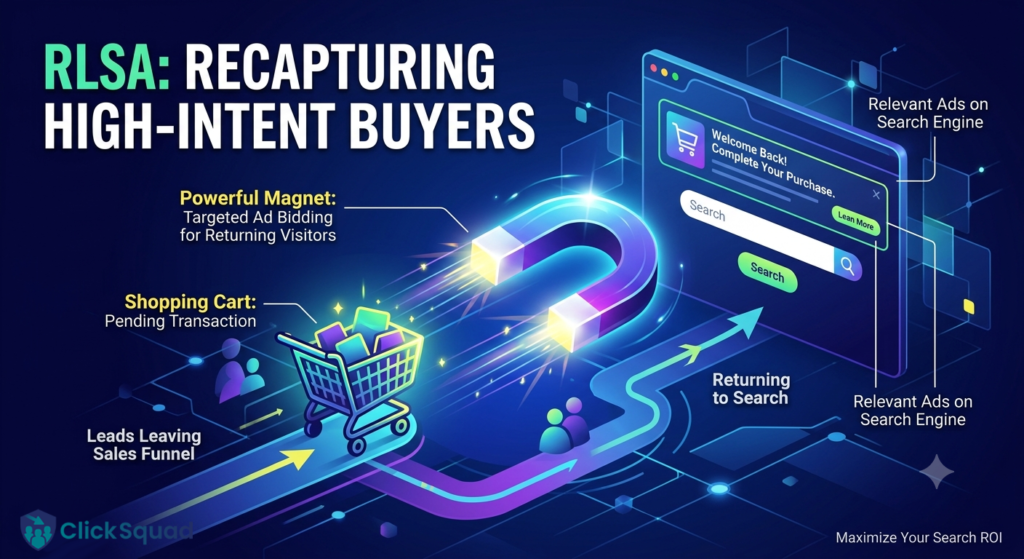
Staring at Google Ads and Search Console dashboards all week makes it easy to forget that those metrics represent real people. I catch myself doing this sometimes. You get so focused on the data that you forget there is an actual person sitting on their phone at night, adding a camera to their cart, hesitating, and closing the tab to check a competitor’s price.
Late one night, I had to extend my working hours to finish a monthly performance report for Ben at Camera Warehouse. We had done the hard work of capturing top-of-funnel traffic, and the site was bringing in thousands of targeted clicks. However, a significant chunk of users stalled right in the middle of the funnel. They knew what they wanted but were not quite ready to buy on their first visit.
Reviewing the campaign metrics the next day with Paul, our founder here at Click Squad, the solution became obvious. We did not need to spend more budget on acquiring cold traffic. Instead, we needed a targeted RLSA Strategy to bring back those exact high-intent visitors the moment they returned to Google.
If your primary goal is Return on Ad Spend (ROAS), treating every single Google search as a cold interaction is an expensive habit. Here is how I use Remarketing Lists for Search Ads (RLSA) to capture the middle of the funnel and actually connect with buyers.
What RLSA Actually Is
Remarketing Lists for Search Ads (RLSA) is a Google Ads feature letting you customise search campaigns for previous website visitors.
Unlike standard display remarketing, where your ad follows a user around the internet while they read the news, RLSA only triggers when that past visitor goes back to Google and actively searches for a keyword you are bidding on.
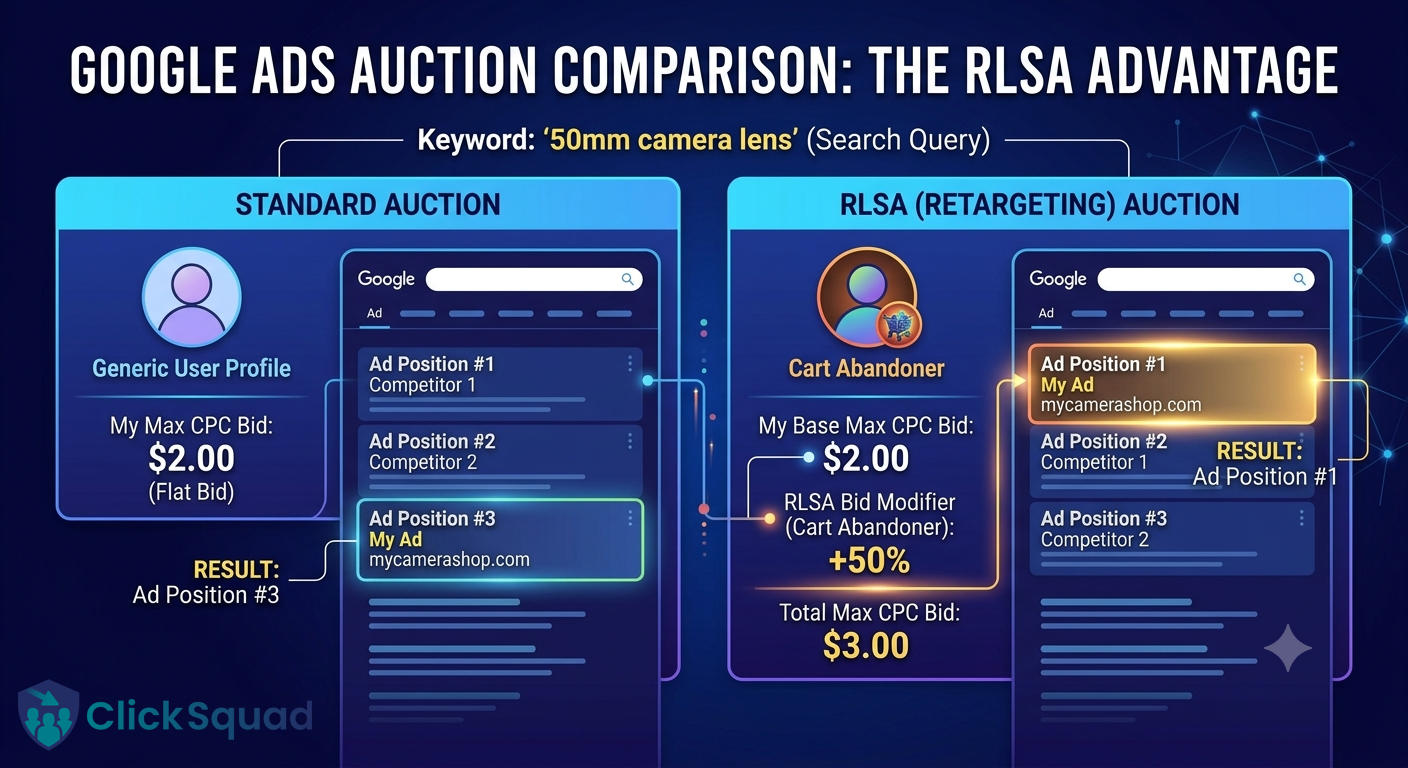
Consider the psychology behind it. A user visits your site, looks at a high-end camera lens, and leaves. Two days later, they go to Google and type “best price for 50mm lens”. With a standard setup, you bid the exact same amount for that user as you do for a complete stranger. With RLSA, you can tell Google you know this person. They were just on your checkout page, so you are willing to increase your bid by 40% to secure the top spot.
This makes it a great middle-of-funnel tool, combining historical browsing behaviour with active search intent.
Why RLSA Scales ROAS
The middle of the funnel is where campaigns either generate profit or burn through budget. Buyers at this stage are aware of their problem and your brand, but they are still evaluating options.
Building a dedicated RLSA Strategy protects your ROAS in three specific ways:
- Higher Conversion Rates: A user who has already navigated your site is much more likely to convert than a cold lead. Bidding higher on returning users naturally leads to a better conversion rate.
- Lower Cost Per Acquisition (CPA): Because the conversion rate on remarketing audiences is higher, your overall cost to acquire that customer drops. This helps your profit margins.
- Budget Protection: You can use RLSA to intentionally exclude past purchasers from seeing your ads for a specific period. There is no reason to pay for a click from someone who bought your product yesterday.
Step 1: Segment Audiences Logically
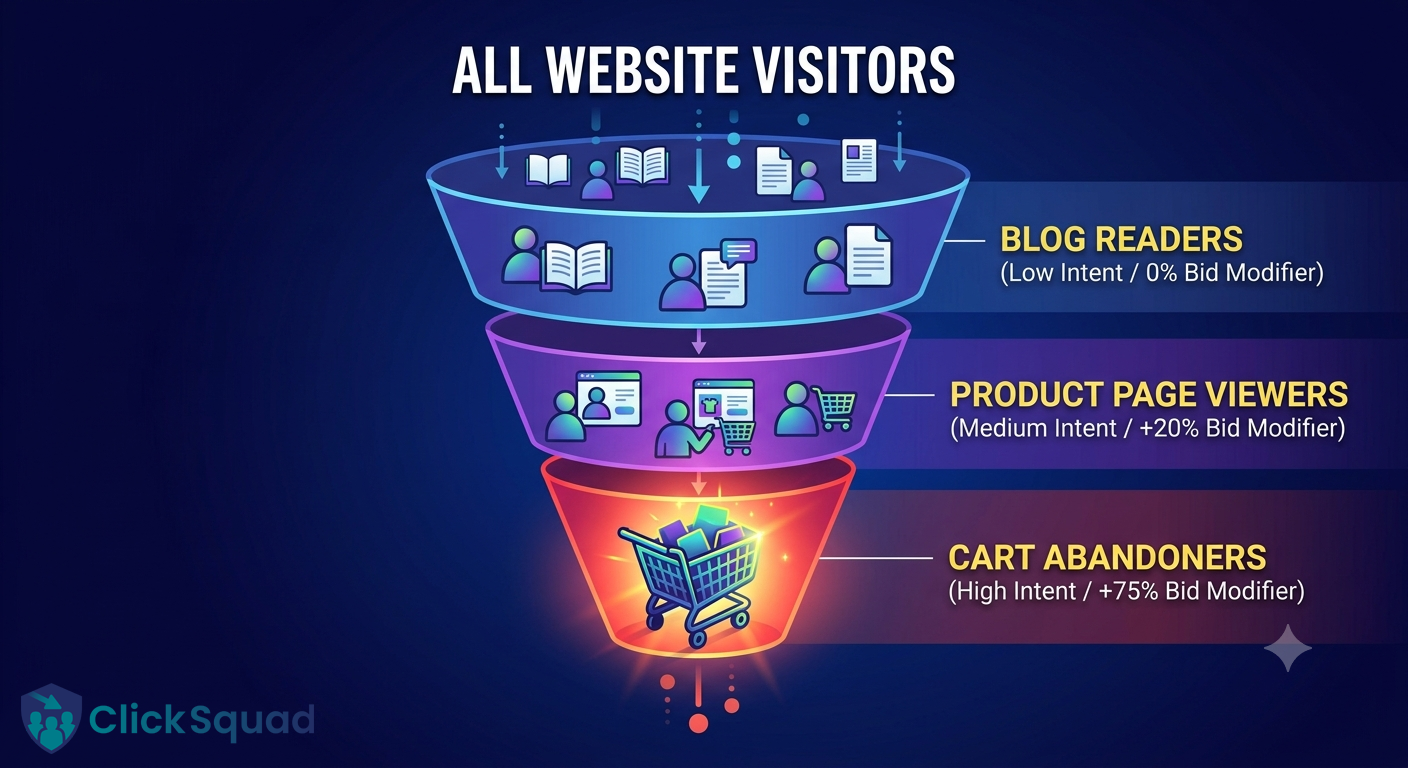
A frequent mistake I spot in agency audits is relying on a blanket “All Website Visitors” remarketing list. That approach simply wastes money. A person who reads one blog post and bounced within ten seconds does not have the same intent as someone who spends five minutes reviewing your pricing page.
Segment your audiences based on engagement depth. I usually break them down into these core buckets:
- Cart Abandoners: The highest intent group. They added a product or service to their cart but left. Bid high to win these users back.
- Product Page Viewers: Users who viewed specific high-value items or service pages but did not initiate a checkout.
- Blog Readers: Low intent. They consume informational content. Keep bids normal or even lower them for this group if they search for commercial terms later.
- Recent Purchasers: Exclude these users entirely or place them in a separate cross-sell campaign.
Step 2: Set Bid Modifiers
Once audiences are segmented, apply them to existing search campaigns as “Observation” audiences. This lets you gather data on how these specific groups perform without restricting the campaign’s overall reach.
After gathering a few weeks of data, apply bid modifiers. If you notice your “Cart Abandoners” list converts at double the rate of your standard traffic, apply a +50% or +75% bid adjustment to that audience. This tells Google Ads to push your ad to the absolute top of the page whenever someone from that list searches for your target keywords.
Step 3: Write Tailored Ad Copy
This is where the strategy pays off. If you duplicate a search campaign and set the RLSA audience to “Targeting” (meaning ads only show to people on the list), you can write completely different ad copy.
Instead of a generic top-of-funnel hook like “Discover Our Services”, speak directly to their mindset. Acknowledge they are comparing options.
Try hooks like:
- “Still Thinking About It? Enjoy 10% Off Your First Order.”
- “Compare Our Features Before You Make a Decision.”
- “Welcome Back. Fast & Free Shipping on All Orders Today.”
When a buyer jumps between three different tabs trying to decide, an ad that feels familiar and offers an immediate incentive is often the final push they need.
Step 4: Use Broad Match Safety Nets
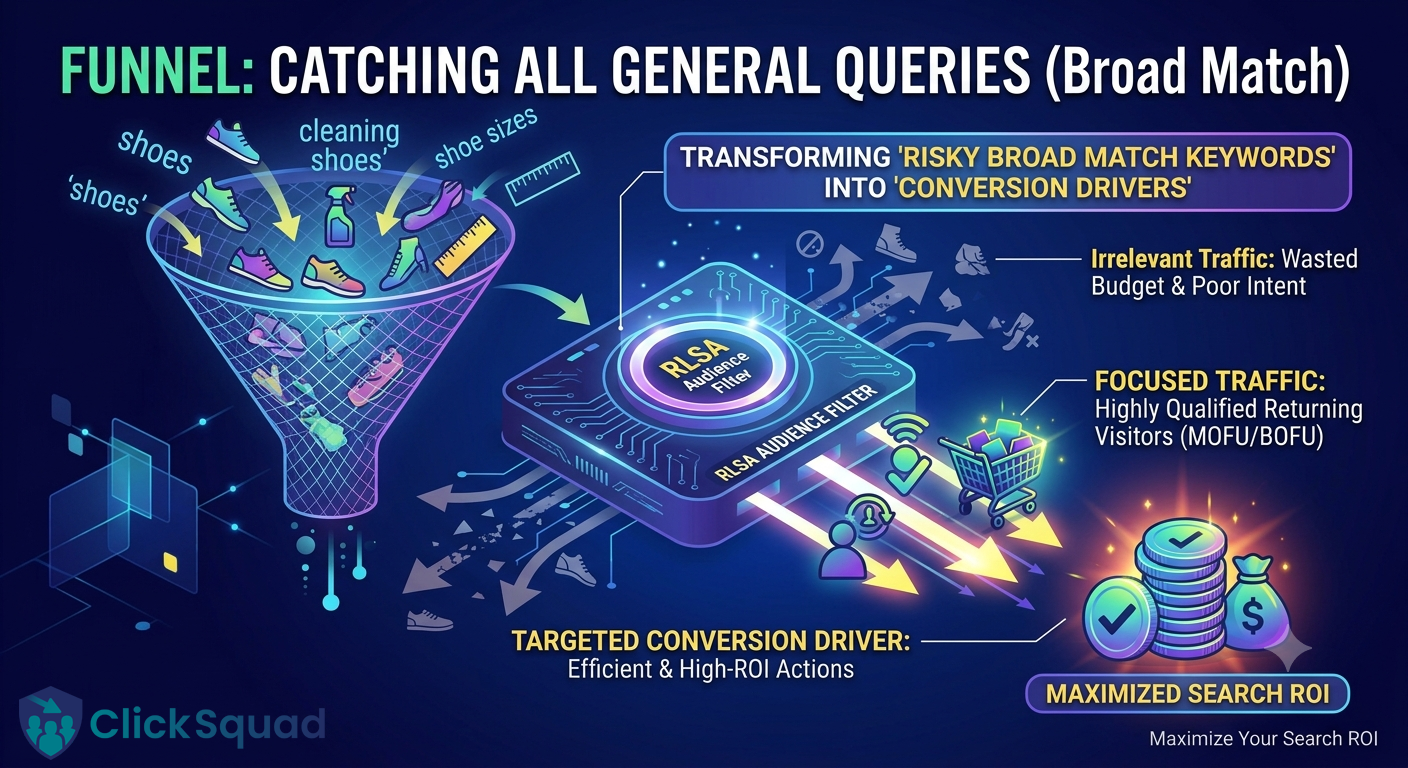
Broad match keywords are generally risky. If you bid on the broad match term “shoes”, Google might show your ad to someone searching for “how to clean suede shoes”. This wastes the budget fast.
However, RLSA provides a great safety net. If you create an RLSA campaign strictly for “Cart Abandoners”, you can safely bid on highly generic, short-tail keywords. Bidding on the broad term “shoes” but restricting the audience to people who almost bought from you yesterday changes the search intent completely. You know they are a qualified buyer, making a broader search query a profitable move rather than a gamble.
Fixing the Funnel Leak
If your search campaigns generate traffic but ROAS remains flat, the algorithm isn’t broken. You are simply letting qualified prospects slip through the middle of the funnel.
Treating every searcher like a stranger is an expensive habit. By layering a smart RLSA Strategy over your existing campaigns, you focus your budget exactly where it matters: bringing back the people who already want to buy from you.