


For years, I’ve had a recurring nightmare with client reviews.
We would look at a marketing dashboard together. On the organic (SEO) side, traffic was going up, and we owned the top spots for all our major commercial terms. We were dominating the real estate.
Then, we would look at the paid search (PPC) side. The lead numbers looked good. Conversion rates were solid. Everyone was happy.
But eventually, the math in my cold cup of coffee would click. We were spending tens of thousands of dollars on paid ads that drove traffic we could have easily captured for free through our existing organic rankings. We were actively bidding against ourselves, wasting a large portion of the budget on leads we already owned.
That frustration is why this shift is so important to me. For too long, PPC and SEO have operated like feuding neighbours, ignoring the truth that they both exist on the same street: human intent. True market dominance doesn’t require separate strategies; it requires a unified mindset.
For nearly ten years, Dynamic Search Ads (DSA) served as our awkward treaty between these two worlds. We built great, semantically rich pages (SEO), and PPC used DSA to instantly capture incremental search volume without the exhausting chore of building keyword lists.
But DSA was a blunt instrument, and the world has changed. As of June 2026, relying purely on text matching to find your audience isn’t just outdated; it’s a waste of money.
The change is here, whether we are ready for it or not. I’ve spent the last six months transitioning our campaigns to AI Max for Search, and while the learning curve was steep, I’m a believer. This is not just an upgrade to a new shiny tool; it is a vital shift toward the only metric that actually pays the bills: Lead Quality.
The Problem with DSA: Technically Right, Emotionally Wrong
To see where we are going, we must be honest about where DSA failed.
On paper, Dynamic Search Ads were a miracle. Instead of manual bidding, you just fed the algorithm your URL. It used your page titles, headers, and content structure (your SEO foundation) to dynamically generate ads and match user queries to landing pages.
I remember the first time I set up a DSA campaign for a B2B client that sold expensive, custom manufacturing software. The leads started rolling in, and we thought we had found a cheat code. But three months later, the sales team was exhausted.
DSA was finding people who wanted “free software templates” or “cheap accounting tools.” Technically, those words existed on our page in a comparative sense. The algorithm was “technically correct,” but it had completely missed the emotion and context of the search.
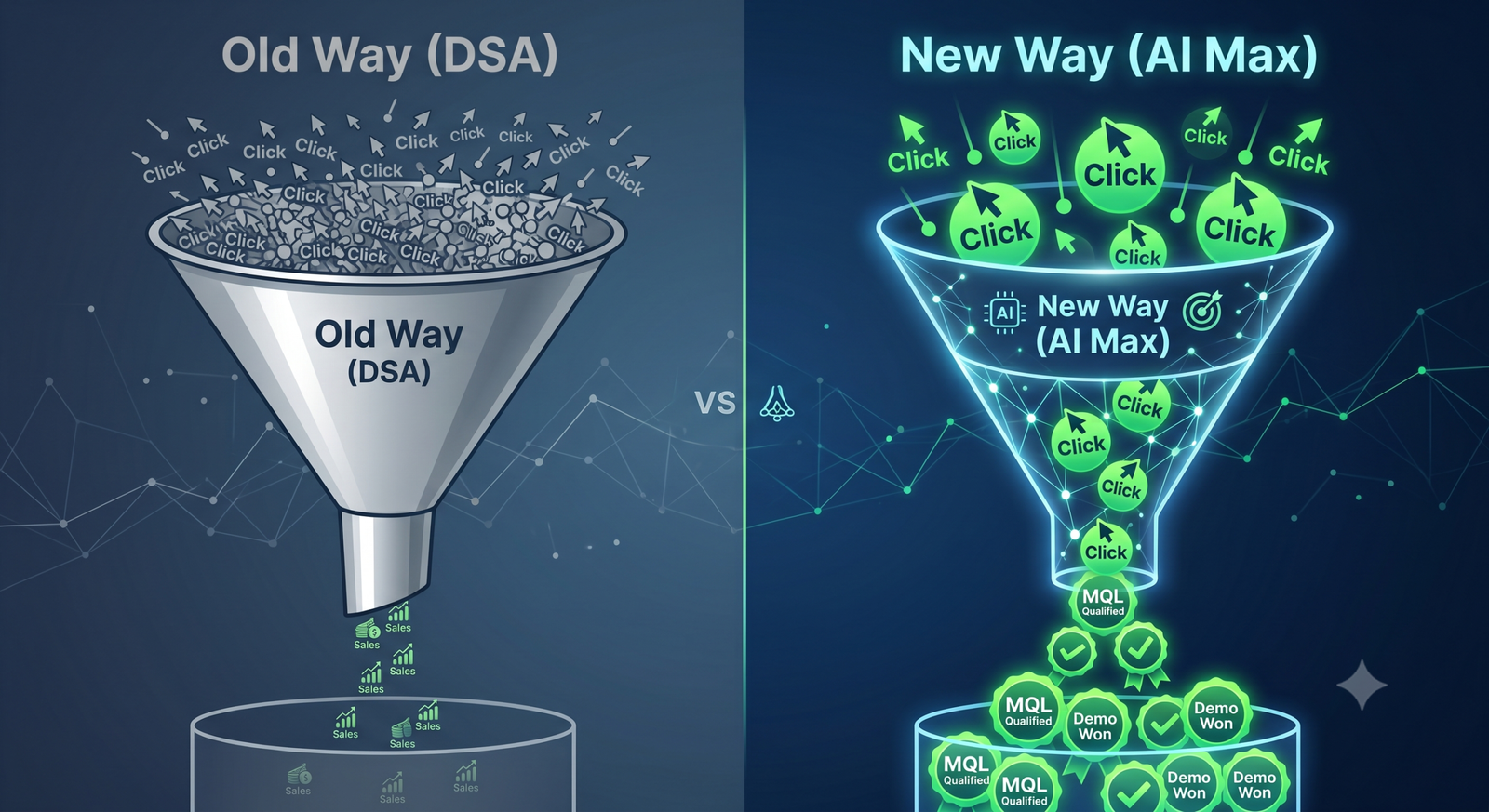
It failed to evaluate true user behaviour or the actual conversion rate. We were winning the placement battle but losing the CPA (Cost Per Acquisition) and ROI war. In 2026, when every click is expensive, that descriptive matching is just a gamble. We were drowning in noise, and DSA was the megaphone amplifying it.
The Promise of AI Max for Search: Predicting Intention, Not Just Words
AI Max for Search is what search automation was always supposed to be. It moves beyond the semantic matching of DSA and adopts a behavioural, predictive model. Its job is to ensure your paid and organic channels finally speak the same language.
If DSA were a dictionary, AI Max for Search is a salesperson who has done their research.
The core difference is Audience Signals. Instead of just matching the words a user types, AI Max is evaluating the human context behind the query:
- Browser and Search History: Has this person spent weeks researching our competitors’ solution?
- App Usage: Are they frequently using complex, professional tools that signify an enterprise role?
- Real-Time Data (CRM): Has this specific user already engaged with our MOFU content and is sitting in our HubSpot database?
- The “Right Now” Factor: Are they searching from a business district on a Monday morning, or on a mobile device on a Saturday?
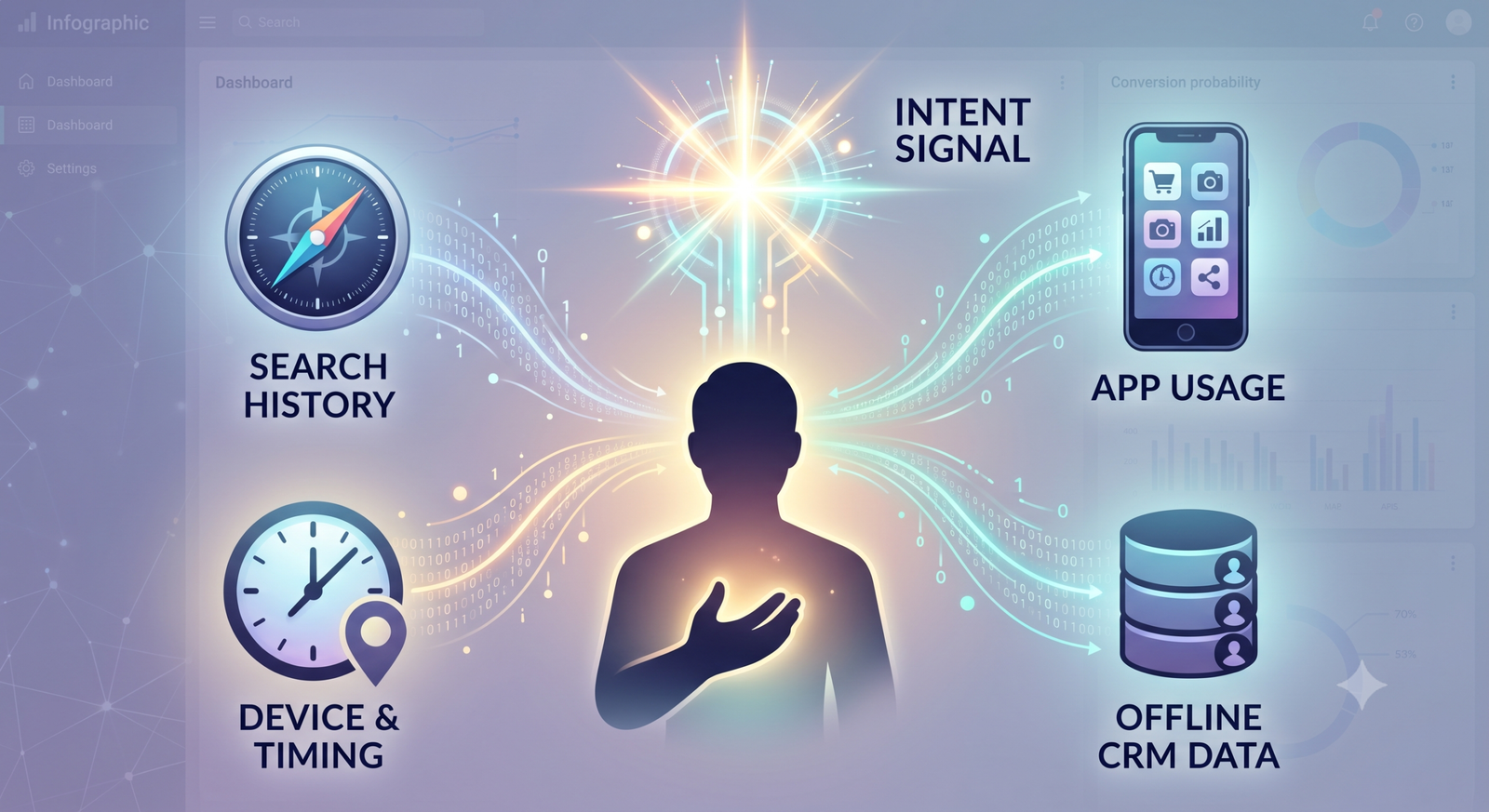
This ensures your ad appears not because the user typed a specific phrase, but because the algorithm predicts this specific person is actively moving through the middle-of-funnel consideration stage and is ready to buy.
The MOFU Mandate: Moving Beyond Clicks to Capture Connection
In 2026, the biggest budget waste I see is optimising for clicks. Clicks are cheap (in value, not price). For any high-value service or complex product, the middle of your funnel is where your campaign succeeds or fails.
This transition is powerful because it forces you to prioritise lead quality. It demands that you move your primary KPI from click volume to conversion value.
People rarely make a complex purchase the first time they hear about you. Their search behaviour changes as they move from broad awareness (“why is my marketing broken?”) to specific consideration (“best marketing frameworks for growing businesses”). You must capture both phases.
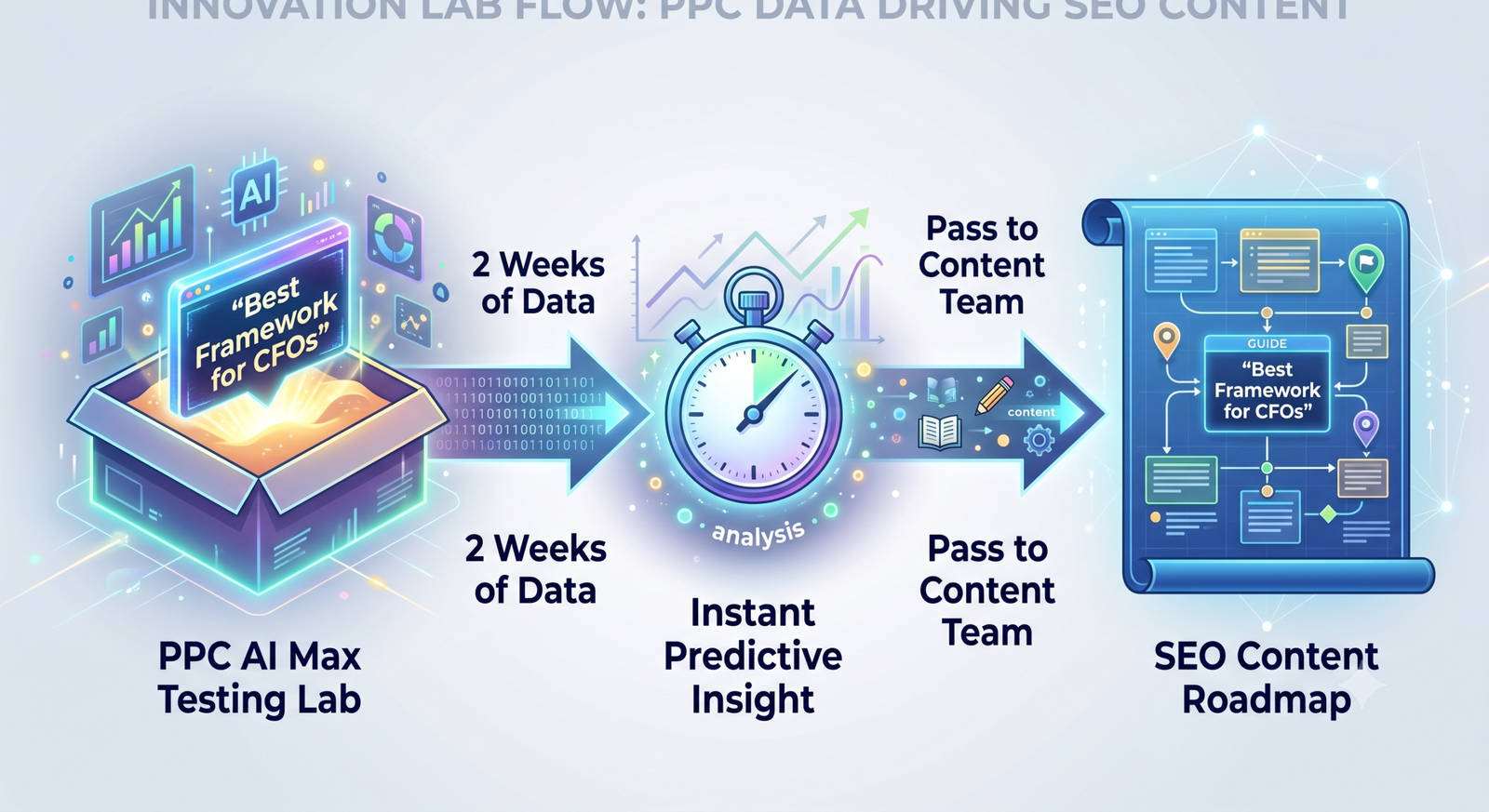
I’ve learned to stop waiting months to see if a new content guide shapes our organic traffic (a slow, large ship). Instead, I treat my AI Max campaigns as my “innovation lab.”
You can test new hooks and calls to action (the PPC sandbox). In weeks, the predictive data will tell you exactly which phrase is generating the highest qualified engagement. I then pass that winning phrase directly to our content team to shape our organic roadmap. We aren’t just building pages; we are building pages that data says will connect.
Five Steps for Making the Handoff Work
This isn’t as simple as checking a box. It demands a new coordinated search strategy. You have to prioritise high-intent data and shared keyword tracking.
Here are the five real-world steps I use to get SEO and PPC finally working together through AI Max.
Strategy 1: The Integrity of Your Data Is Non-Negotiable
AI is a mirror. It just reflects what you feed it. If your landing pages are poorly responsive on mobile, have poor heading structures, or load slowly, the AI will reflect that as a poor user experience and inflate your ad costs. This is where your SEO foundations directly save you cash.
But the most critical part? You must integrate your CRM with the ad platform. Upload “real” conversion events like “MQL Qualified,” “Demo Booked,” or “Opportunity Won.” If you optimise for “Page Views” or soft conversions, AI Max will efficiently find you thousands of low-intent clicks and bankrupt your budget.
Strategy 2: Be Gentle: Use Parallel Testing as Your Handoff
DSA served a valuable purpose, and turning it off immediately before AI Max stabilises can cause traffic drops that will get you fired. Algorithms update constantly, and I’ve seen a reliable organic page drop a few positions overnight. Parallel testing gives you a buffer.
Do not use smart bidding (Target CPA/ROAS) on AI Max from day one. I start with “Maximise Conversions” and run it alongside DSA. This acts as a gentle handoff, allowing the algorithm to learn the behavioural patterns of our qualified traffic while the stable DSA keeps the lead pipeline open.
Only once AI Max consistently matches the Lead Quality (not just volume) do I start dialling back the DSA budget.
Strategy 3: Mining the Report for Hidden Gold
The Search Term report shouldn’t just be an “expense check.” It’s a goldmine of insight.
| Step | Action | Personal Outcome |
| 1 | Review PPC Search Term Reports | Find the phrases triggering actual revenue. |
| 2 | Spot unproductive search volume | Find expensive, non-converting terms (the DSA holdovers). |
| 3 | Pivot the Organic Roadmap | I build content around the exact phrase the AI tells me is already converting. |
I found an entire service line for a client just by analysing terms with low click volume but unusually high conversion rates in our AI Max reports. We didn’t even have a page for that specific need; the AI had to find it. We built a guide around it, and it’s now our highest-converting organic page.
Strategy 4: Granville Matters in Asset Groups
Do not make the classic mistake of creating one giant, catch-all “bucket” campaign. In AI Max, you create “Asset Groups,” and they need focus.
Instead of one Asset Group for “B2B Software,” I break it down into: (1) B2B Software for HR, (2) B2B Software for IT, and (3) B2B Software for Finance.
Provide highly specific headlines, descriptions, images, and distinct landing pages for that unique MOFU audience. That’s how you lower your cost-per-click and win the placement.
Strategy 5: Protecting Your Name
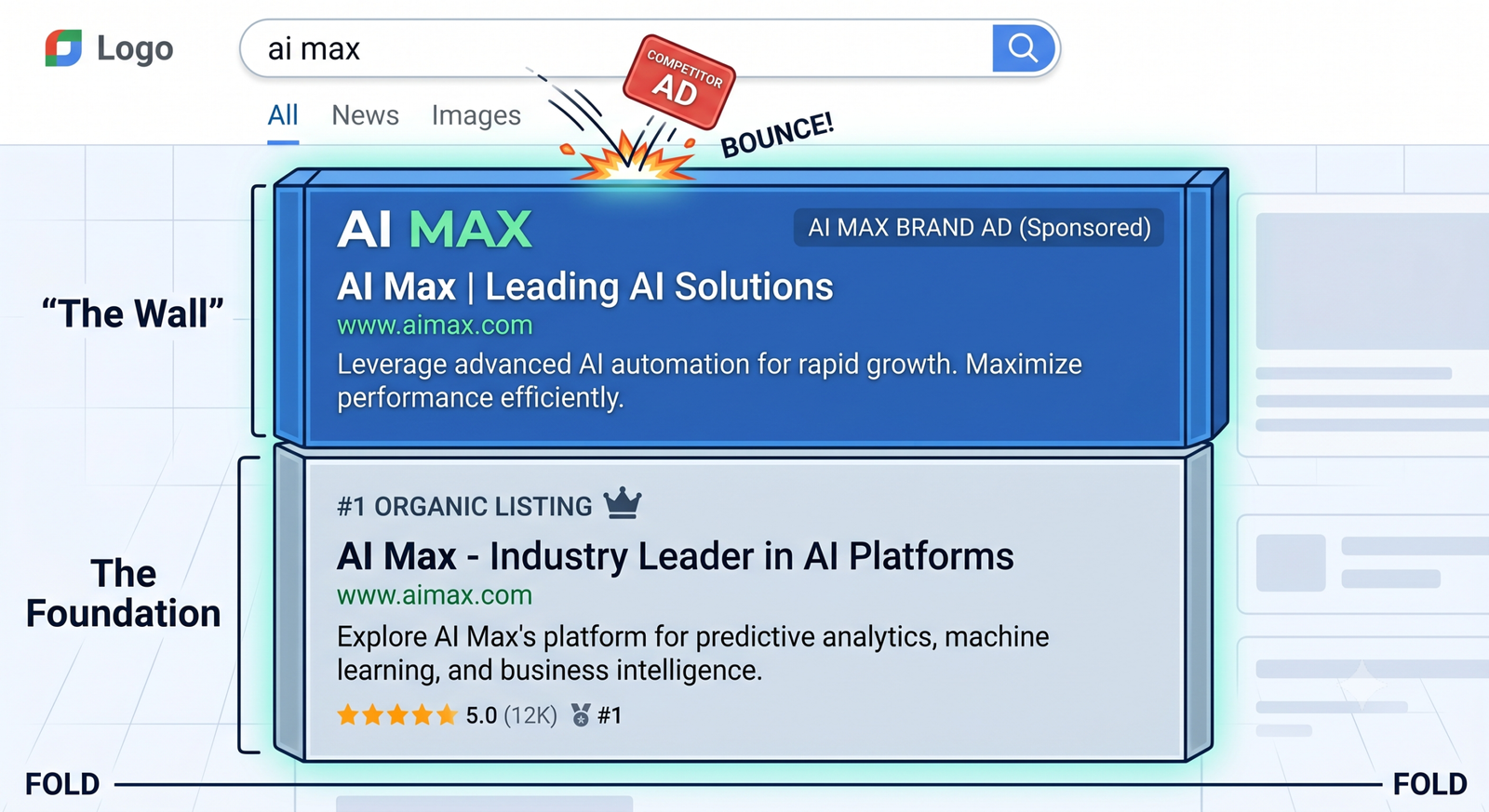
It’s infuriating when a direct competitor bids on your business name, stealing leads right at the finish line. Simply owning your organic number-one spot is not enough. Competitors are sitting above you on the SERP.
I use a low-cost, high-conversion AI Max brand campaign right above our number-one organic listing. This combination (MOFU authority + PPC efficiency) creates a complete wall, preventing competitors from taking our high-intent traffic. Industry publishers prefer linking to market leaders; when they see your brand dominating both the paid ads and the top organic spots for major terms, your credibility naturally increases.
This Is a Shift of Connection, Not Just Clicks
The deprecation of old descriptive matching and the mandatory shift to AI automation forces an internal conversation. Breaking down silos is hard. You have to stop viewing paid campaigns and organic content as competing budgets and instead treat them as a single search ecosystem. Achieving total coverage means paid data shapes organic content, and technical optimisation refines paid performance.
Stop optimising for visibility and start optimising for human connection.
Prioritise lead quality, integrate your CRM signals, align technical SEO with your ad spend, and use predictive data to finally dominate your target search market from top to bottom.