

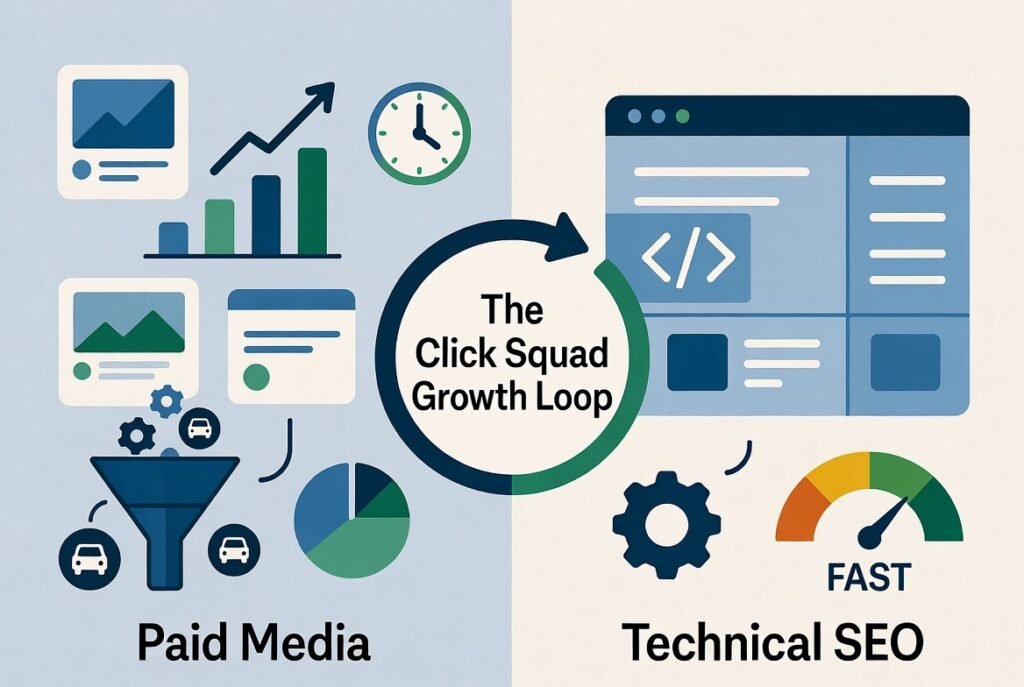
Telling someone that a faster website will actually lower their advertising costs usually earns me a confused look. It sounds like a contradiction. But I see this disconnect all the time when I sit down with new clients at Click Squad. Often, the paid media team is busy buying traffic for today, while the organic team builds the website for tomorrow.
When these two teams aren’t talking, you end up quietly burning through your hard-earned marketing budget.
Julius, our Head of Social Media Ads, and I talk about this constantly. His brilliant ad campaigns can only perform as well as my technical site architecture allows them to. Google doesn’t look at your business in a vacuum. It uses the exact same signals to rank your organic pages and evaluate your paid landing pages. If your website feels clunky, slow, or broken, your paid ads take the hit. You end up paying a premium for every single click just because the foundation is a bit shaky.
Understanding how your technical SEO connects to your Google Ads Quality Score is the first step toward making your marketing work in harmony. Let’s look at how fixing your technical baseline directly lowers your Cost Per Acquisition and makes your advertising budget work so much harder for you.
What is a Technical SEO Audit?
When business owners first come to us, they often think SEO just means stuffing keywords into blog posts or chasing backlinks. Those things matter, of course, but they mean nothing if search engines (and real people) struggle to actually use your website.
Think of a technical SEO audit as a deep health check for your digital home. We look under the hood to find the hidden roadblocks that hold your performance back.
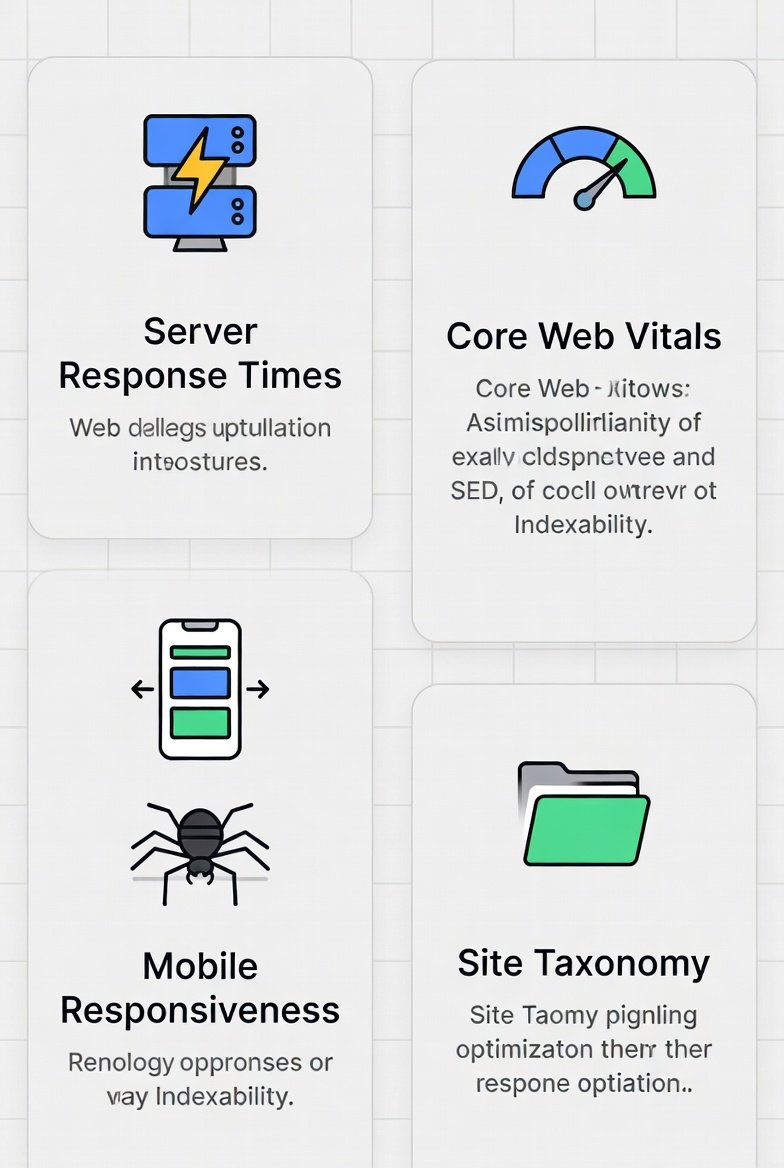
During this process, we look at critical elements like:
- Server Response Times: How quickly your website wakes up and delivers what the user asked for.
- Core Web Vitals: Google’s specific measures for how smooth, stable, and fast your pages feel to a real human.
- Mobile Responsiveness: How comfortably your site fits into the palm of someone’s hand.
- Indexability: Making sure search engines can read your site without getting lost in dead ends.
- Site Taxonomy: The logical flow and structure of your pages.
Fixing these elements naturally lifts your organic rankings. But the real magic happens when you realise these exact same upgrades tell Google Ads to start charging you less.
The Hidden Link: Understanding Quality Score
To see how technical SEO impacts your paid ads, you need to understand how Google prices a click. Google Ads operates on an auction system, but it is not just a bidding war where the richest person wins. Google cares deeply about the user’s experience.
That is why they use a metric called Quality Score (graded from 1 to 10) to figure out your actual Cost Per Click (CPC). As outlined in the official Google Ads Support documentation on Quality Score, Google calculates it using three distinct pillars:
- Expected Click-Through Rate: The likelihood that someone will click your ad when they see it.
- Ad Relevance: How closely your ad matches what the person is actually searching for.
- Landing Page Experience: How helpful, transparent, and functional your webpage is once they click.
Your paid media manager handles the first two. But your technical SEO entirely dictates that third pillar.
How Technical SEO Drives the Landing Page Experience
Google is very clear: a good Landing Page Experience means a fast, helpful, and easy-to-use website. If you write the best ad in the world but send people to a slow, confusing page, Google penalises you.
Here is how the things we fix in a Click Squad technical SEO audit directly boost that score.
1. Page Speed and Time on Page
We have all been there—tapping a link on our phone and staring at a blank, loading screen. Modern buyers have zero patience. I have watched businesses pour thousands of dollars into beautiful ad campaigns, only to send those expensive clicks to a landing page that takes five seconds to load.
When people experience that friction, they leave immediately. This consumer impatience isn’t just an assumption; a widely cited think with Google consumer mobile speed study notes that as page load time goes from 1 second to 5 seconds, the probability of a mobile site visitor bouncing increases by 90%.
When people bounce, Google sees that low Time on Page, assumes your website offers a poor experience, and drops your Quality Score. We target these exact bottlenecks during an audit. We compress images and clean up the code so the page loads instantly. It removes the friction, keeps people engaged, and signals to Google that your site is worth showing.
2. Flawless Mobile Usability
Most of your traffic comes from phones. If someone clicks your ad and has to pinch and zoom just to read your text, or fight a pop-up that covers the whole screen, you have lost them.
Google judges your paid ads with the same strict mobile standards it uses for organic search. A technical audit finds those frustrating mobile quirks. We fix them so your users glide smoothly through the page, protecting your Quality Score in the process.
3. Clean Architecture and Navigation
When someone clicks an ad, they want an immediate answer. If they land on a messy page with broken links or a confusing menu, they feel frustrated and leave.
Technical audits clean up that journey. When people can easily find your contact form, read your pricing, or navigate to the checkout cart without hitting a dead end, Google rewards you for being genuinely helpful.
The Financial Reality of a Higher Quality Score
The technical details are great, but what does this actually mean for your bank account?
Your Ad Rank decides where you show up on the page. Google calculates this by multiplying your bid by your Quality Score. Because it is a multiplier, a high score lets you beat competitors who are spending way more money than you.
Imagine you bid $5 a click, and a competitor bids $10. If you have done the technical work to earn a Quality Score of 10, your total score is 50. If their site is slow and clunky, earning a Quality Score of only 4, their score is 40.
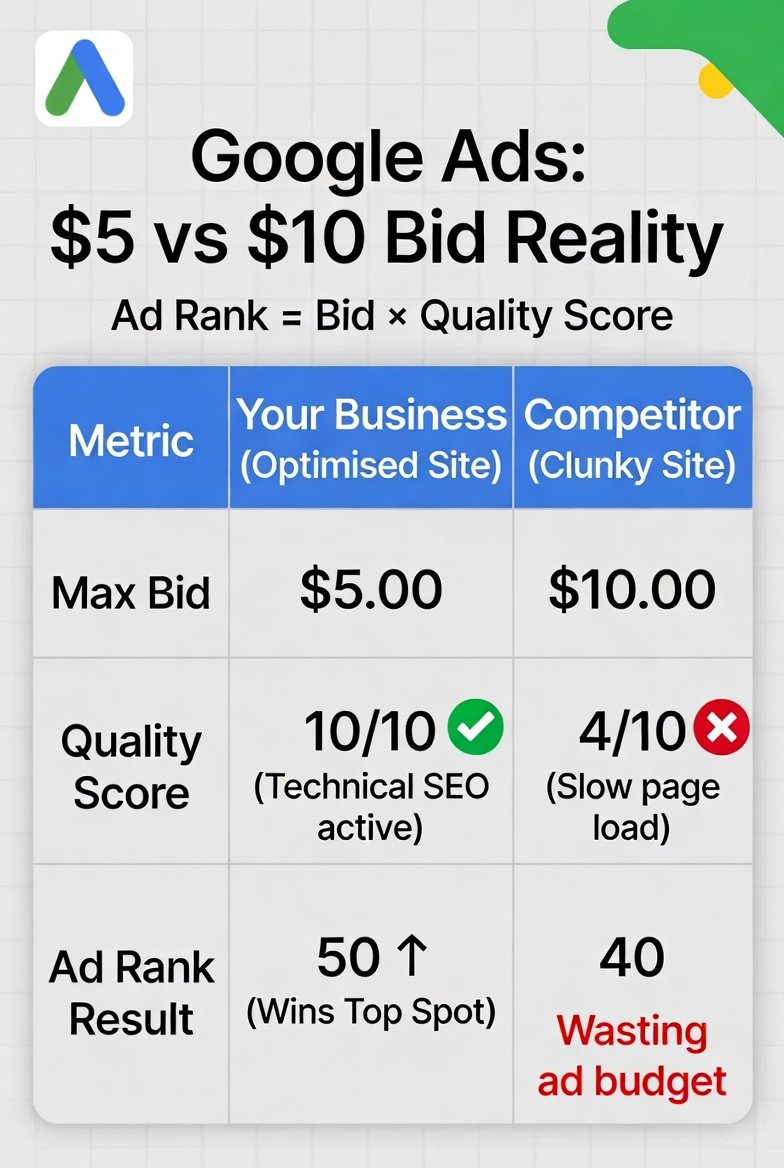
You win the top spot, and you pay less to get it. A comprehensive technical overhaul pays for itself by forcing Google to give you a discount on your ads. Learn more about how structural and technical efficiency cuts costs in our PPC Keyword Siloing Case Study.
Bringing It All Together
Good marketing isn’t a bunch of disconnected tactics anymore. It is a living, breathing ecosystem. You can’t expect a great return on your ad spend if you send people to a website that isn’t ready to welcome them.
Before you increase your ad budget, make sure your digital home is built to convert. Find the hidden roadblocks. Speed up your site, smooth out the mobile experience, and give your users the journey they deserve. When you do, you will see your CPC drop, your Quality Score rise, and your revenue grow.