


I remember a frustrating meeting a few years back with a new client. He slid his laptop across the table, pointed to a competitor sitting in the number one spot on Google, and asked a very fair question. “I have the budget. If I am willing to pay more than them, why is their ad showing above mine?”
It is a common pain point. Many people assume the Google Ads platform is just a traditional auction house. You bid ten dollars, the other business bids five, and you take the top spot. It sounds perfectly logical.
But over my decade in the search industry, I have had to break the news to hundreds of clients that Google cares about the user experience just as much as your wallet. If they only showed bad ads to the highest bidder, people would stop clicking altogether. To actually get your brand seen at the top of the funnel, we have to look at how the system really works.
The Secret Formula: Ad Rank
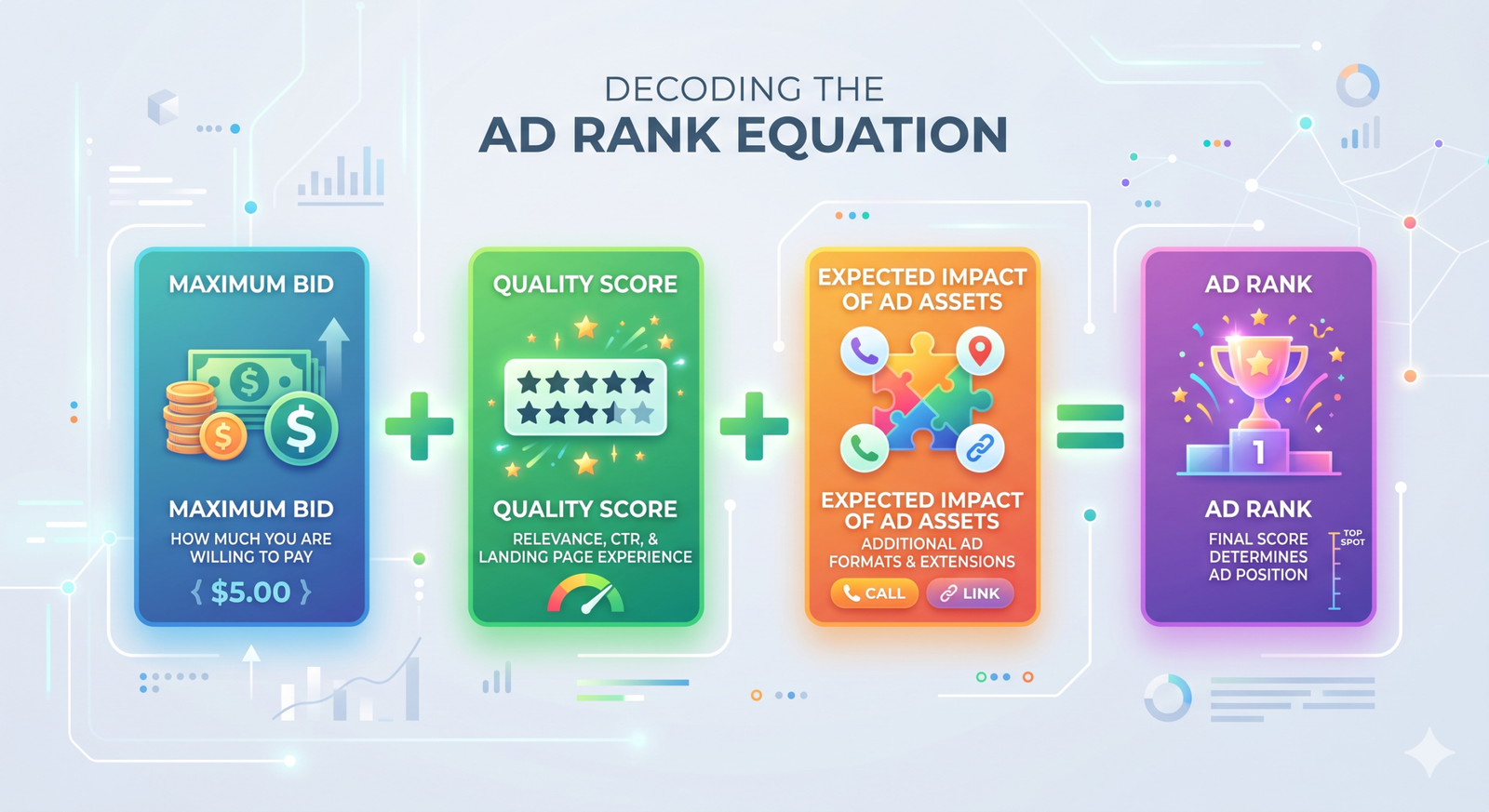
Every time someone searches, a quick calculation happens in the background. In milliseconds, the algorithm looks at everyone bidding on that keyword and assigns them an Ad Rank.
This score decides your fate. The highest Ad Rank gets the top spot. But your Ad Rank is not just your bid. It is a balancing act between the cash you are willing to spend and the quality of the answer you provide. The exact math is kept quiet, but the core pillars are completely open.
Pillar 1: Your Maximum Bid
This part is straightforward. Your bid is the absolute most you are willing to spend for one click.
When testing different PPC Bidding Strategies, your bid tells Google how aggressive you want to be. But here is the great part. You rarely pay your actual maximum. You only pay just enough to beat the competitor directly below you. I always reassure nervous clients that we can bid confidently to stay competitive without blowing the monthly budget on a handful of clicks.
Pillar 2: The Quality Score
This is the great leveller. Quality Score is how Google rewards good marketers and penalises lazy ones. It scores your ad relevance out of ten.
A high score is literally a discount. A competitor can bid twice as much as you, but if their ad is poor and your Quality Score is high, you win the top spot and pay less.
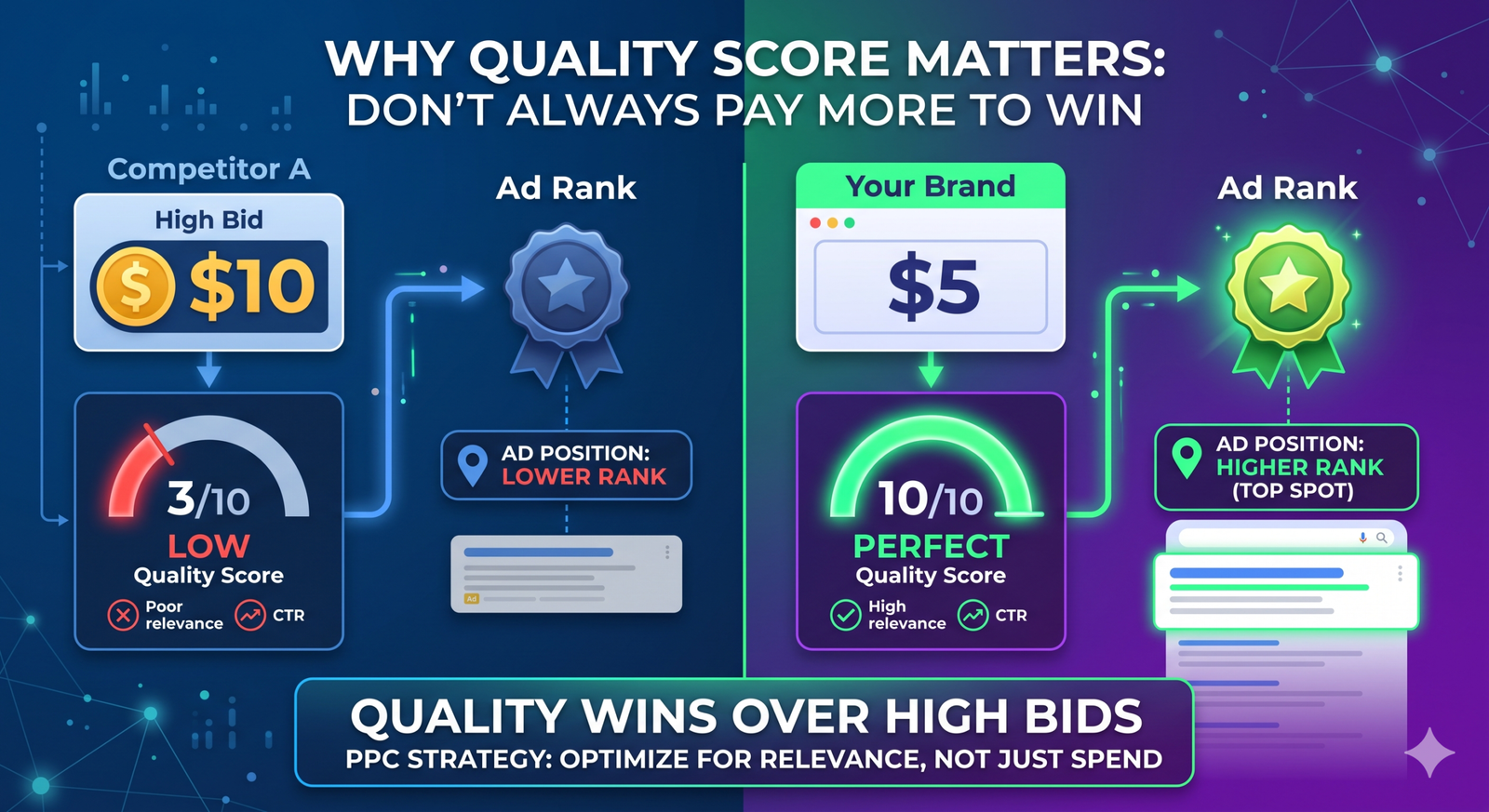
I see this all the time when taking over messy accounts. We once audited a campaign where a business was bidding heavily on “commercial solar panels”, but the ad sent people to a generic page about residential batteries. They were losing the auction because of three things:
- Expected Click-Through Rate (CTR): People were ignoring the ad, so Google dropped their rank.
- Ad Relevance: The copy did not match the search intent.
- Landing Page Experience: The destination page had nothing to do with what the user actually wanted.
Fixing these elements can drop your costs almost overnight.
Pillar 3: The Impact of Ad Assets
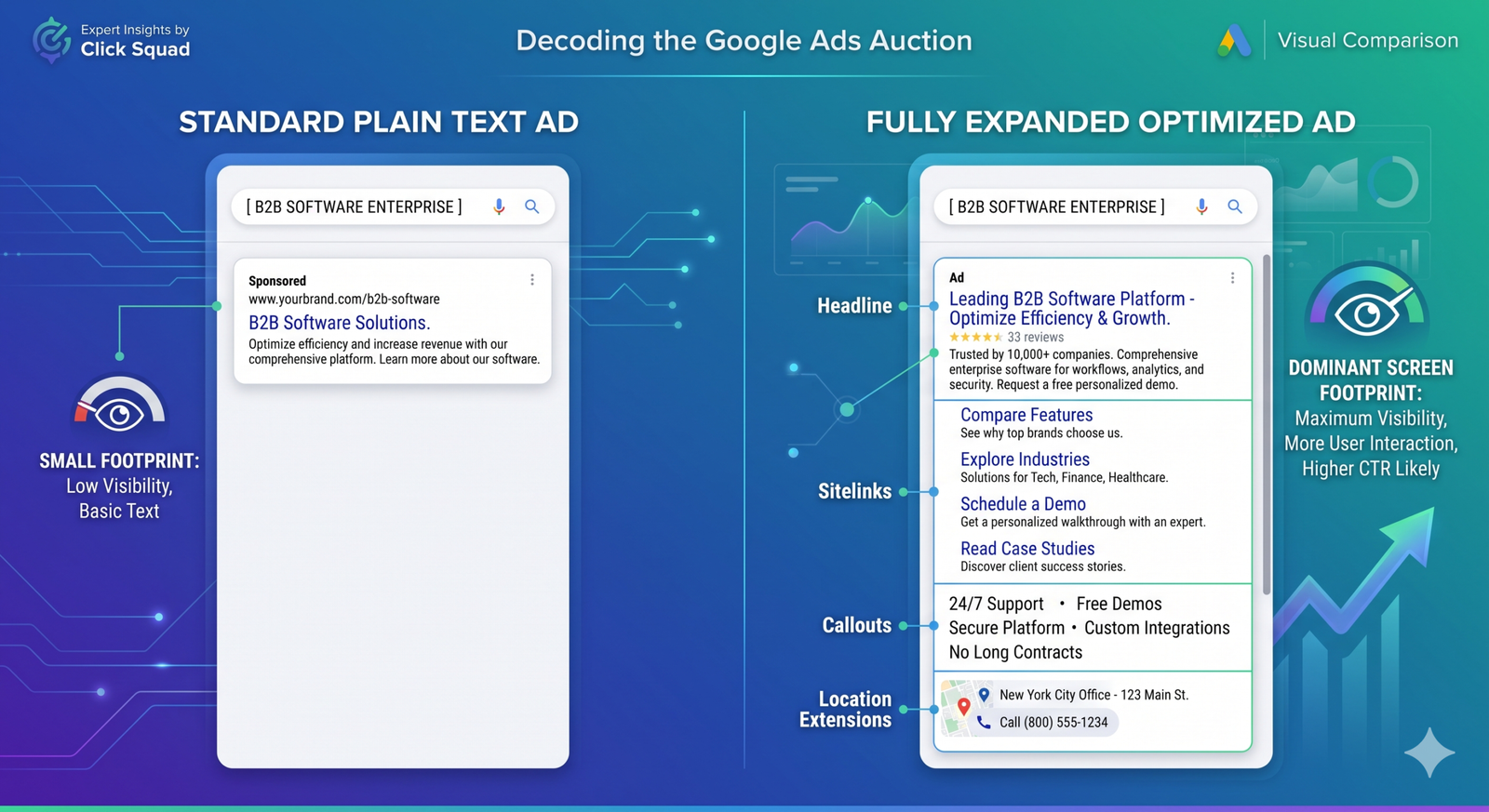
Google wants ads to be helpful. That is why they give you ad assets (what we used to call extensions). These are your sitelinks, call buttons, and location details.
During the auction, Google estimates how these extra links will help the user. If you use them, you get a boost. Leaving them blank is like handing out a business card with no phone number on it. It just leaves free visibility on the table.
Aligning the Auction with Your Goals
When targeting users at the top of the funnel (TOFU), you usually just want people to know your brand exists. Your main goal is View Rate or Impression Share.
Understanding the auction helps you pick the right strategy. If your Quality Score is strong, you can use automated bidding to ensure your ad shows up at the top of the page a set percentage of the time. Trying to bully your way to the top by manually throwing money at a bad ad is the fastest way to burn your budget.
Playing by the Rules to Win
The whole system comes down to one simple truth. Relevance wins.
You cannot buy a dominant search presence if your message ignores what the user actually needs. To win consistently, align your budget with a genuine desire to help the searcher. Write clear ad copy. Build fast pages. Give people the answers they are looking for. When you focus on the user, the auction stops feeling like a rigged game and starts working like a reliable growth engine.